Overview
Power amplification, or the last stage of gain in a hi-fi system, can be described in its simplest form as a ‘modulated power supply’ required to drive a loudspeaker.
Historically, they can be categorised into three main groups: class A solid state and tube; Class AB solid state and tube; then variants, e.g. Class D, etc.
The prime function of a power amp, like the raison detre of all good hi-fi, is to add nothing nor to take anything away from the signal being amplified.

However, the more common methods employed for this task often fell short of what was/is needed to achieve accurate mirror images of the signal. In addition, to match the demands of ever more current hungry and falling loudspeaker efficiencies, more devices were employed, which gave the necessary power at the expense of ‘switching distortion’ due to the class B operation of the amplifying devices, which although difficult to measure, is very obvious to the ear.
Single-ended class A tube amplification, the true foundation of all hi-fi amplifiers, have existed since the 1920’s, but inevitably have suffered to date from their own equally as bad list of problems.
Class A, single-ended amplifiers were and are the ‘holy grail’ for many enthusiasts, but suffer from almost masochistic, hair shirt like problems. Low outputs are often the norm, requiring super efficient speakers. A valve amp of this type has typically a liquid euphonic mid range with a greatly reduced bandwidth, creating totally unrealistic reproduction at frequency extremes. Levels of distortion which would be unacceptable if found in solid state amplification are tolerated, as in some cases’ they can have a perceived cancelling effect of some of the anomalies added by the loudspeaker itself. Some valves have a notoriously short life but all need to be biased properly to perform at their best.
Class AB valve amps behave in a similar way to their solid-state cousins [but not exactly, due to the non existence of PNP valves] however; by splitting the driver signal, using some form of phase splitter, and varying the amount of steady current needed to reproduce the audio signal, all while trying to keep the amplifier relatively efficient, you risk forcing the tube to exist in a far from ideal environment, which often results in added noise, distortion, and in many designs leads to premature valve failure.
All traditional valve amplifiers suffer from the fact that their control circuitry may have changed in terms of the components utilised, but have changed little in concept and design in the last 40 years.
There is however more to the problem than that. In order to create a believable stereo image (‘stereo’ from the Greek ‘stereos’, meaning solid or combining form) many critical problems are required to be solved.
Why the need for ultra wide bandwidth?
To ensure that phase is kept intact throughout the audio bandwidth, it is far from ideal to just design and build audio amplification with a restricted 20Hz – 20KHz bandwidth (the theoretical limit of human hearing) as phase shift will destroy the subtle spatial cues contained in the signal and not only strip the harmonics from the fundamentals in the music, but in short cause the sound arriving at the listener to bear little resemblance to the sound arriving at the microphone on the day of the recording. The result is a distorted image of the performance with tonal aberrations. It will never get even close to reproducing the original performance.
So why use valves? First and foremost, valves are inherently very linear devices; without the need for huge amounts of feedback to control their gain, and linearity. Secondly; Solid-state amplification can suffer from varying percentages of higher order harmonic distortion i.e., 3rd, 5th, 7th, 9th, etc, which even in small amounts is widely accepted to be much more objectionable than the often higher amounts of lower order harmonics i.e., 2nd, 3rd produced by valve amplification, therefore’ in most cases the distortion produced by a valve amplifier is of a more audibly acceptable type.
O.t.l (output transformer less) valve amps can suffer from the same disastrous failings as many solid state designs! also valves are high impedance devices and therefore not intended to drive low impedance loads i.e.; loudspeakers direct!
By choosing as a goal to design an ultra low noise, ultra wide bandwidth, hyper linear amplifier range, and by utilising the best attributes of two technologies (tube and solid state) it was decided, rip up the book that had its grounding in the 1930s, and devise a means of fulfilling the promise and capability of valves that had never even been approached with conventional circuitry.
Tube Distinctions began researching the project which was to take them backwards in time to look at designs From 60 years ago, and forward in time to discover the fundamental physics that governed the flow of electrons within a vacuum valve/tube.
We deduced that many valve designs suffer from the same major disadvantages; eg. while relying on one valve to drive another, the circuitry used to control the valves set parameters is utterly inadequate, Also; the power supply’s used having relatively high impedance; have little affect on controlling’ and therefore; impeding the valves ability to modulate it [the power supply] over a wide range of the audio frequency bandwidth, this is an obvious short fall, as at certain frequencies and amplitude, the valve will tend to modulate the power supply instead of driving the following valve circuitry’ or the loudspeaker!
The support circuitry and hardware directly affect the performance too, eg; the capacitance of the board, the cable used, and poor archaic circuit topology destroy the top end bandwidth; combine this with a high output impedance of the first valve; and you have a situation akin to a ‘motor cycle pushing a truck’. The transient response by this time has died a death; plenty of mid range but no extremes, and no control.
To put this in perspective, let us look at what some mainstream market leaders of valve amplification publish about their products.
Distortion is typically measured at 1 watt. It is all too obvious why, in that any more power produces more distortion. If we were happy to listen at 1 watt, all would be well, but it is obviously unrealistic for most listeners.
• Distortion figures are published measured at 1 KHz, giving a tiny snapshot of the true picture. If they came clean with the real figures across the whole bandwidth, chances are it would be a completely different story.
• Accurate noise figures of valve amps are rarely published, as rather like a lady of a certain age, they are very conscious of their size.
• Distortion figures of 0.5 and even 1%: This sounds impressive but compared with solid-state amplification of a similar size is hundreds of times greater.
• Bandwidth figures measured at again 1 watt: in order to give the best impression, those brave enough to publish full power bandwidth figures attempt to fudge the issue quoting –3dB points, showing conclusively that they are not 24 Bit compliant.
• Phase response is rarely mentioned.
The previous info is derived from the current promotional material of some of the market leaders in valve amplification. What makes this all the more meaningful is that it relates to class AB amplification. The statistics from our direct competitor i.e. single ended Class A amplification shows typically bandwidths of 20Hz – 25 KHz with noise and distortion figures of ‘Less than 3%’.
Due to the limits of conventional amplifier technology widely used up to now, we have somehow come to regard these statistics as impressive and even virtuous.
It is strange to relate that most conventional single ended valve amps are unable to reproduce the bandwidth of most high-end cartridges, let alone the dizzy heights achievable by DVDA !!!
We felt that a change was long overdue…
In the Soul Series amplifiers, the valve is placed, arguably for the first time in hi-fi history, in a totally controlled environment.
In many conventional designs, the current for the valve (i.e. the current that determines and controls how much power can be drawn by the valve) is set usually by a capacitor and a resistor combination, This is somewhat inadequate, as the goalposts are constantly moving with the signal. Putting the valve into a stressed and fluctuating environment where [arguably] it can never reach a steady state.
To control the valve adequately in the Soul Series, seven circuits were designed with approximately 200 components controlling each single valve 15-watt power module. These lock the valve into the ideal linear operating environment. Each of the circuits can be run independently of each other, most of which are populated with surface mounted devices and our own discrete hyper-regulators, with proprietary voltage references.
This provides a noise floor at the output of the amplifier in the microvolt domain. With a Soul Series on full gain, very little noise can be heard at the speaker, even with one’s ear up against the cone! Many conventional valve amplifiers have a noise floor typically of around 50 mv or more, some 50 times greater, burying dynamic range and resolution and certainly audible at full gain without one’s ear to the cone! This unique approach has other benefits, in that it transforms the reliability and life of the valve. We are quoting figures of a three year useful life, but we predict that many will last longer.
Why push the limits of the bandwidth and why is it important?
As discussed earlier, the wider the bandwidth that can be achieved, the more linear the signal circuit design’ and the lower the phase errors in the audio bandwidth!
This means that faithful three-dimensional sound staging and imagery, with true perspective and harmonic realism, will [arguably] for the first time be achievable from an audio frequency valve amplifier, with the added benefit of the lowest distortion ever from a class A, single-ended Tetrode design. This unique approach helps the listener to hear recordings in a way rarely achievable before; as most of the negative effects of the audio amplification we have come to unconsciously accept are no longer present.
In the worse case scenario, our smallest version of the Soul Series, where a single valve 15watt module is driving a loudspeaker via it’s output transformer, still produces a ‘flat’ frequency bandwidth of 20Hz to over 120KHz. In addition, the phase remains flat to 60 KHz.
To obtain more power the modules are paralleled. This has a threefold effect…
• For every paralleled pair the power doubles.
• For every paralleled pair the noise is reduced.
• For every paralleled pair the distortion is reduced.
The measured performance of the 30-watt stereo has an increased bandwidth flat from 20Hz to over 130 KHz, with a phase response flat in excess of 60 K.
This means that the Soul Series has phase accuracy many times greater than the signal bandwidth of most of the single ended amps ever built.
Unlike conventional amps, the signal circuitry in the Soul Series is semi-floating and not directly referenced to mains earth. This is vital as mains born pollution can add to noise on the signal, which reduces resolution and dynamic range.
Unlike other single-ended amps, the Soul Series clips symmetrically; those of you who have heard a conventional single-ended triode amp clip will know what we mean.
All signal circuitry is DC coupled (no servo’s), compared with conventional valve technology where AC coupling via capacitors is the rule. Many of our competitors try to improvise by advertising the advantage brought about [or not] by the use of exotic variants. All types of capacitors need time to charge and discharge. The more expensive Polypropylene and Teflon caps are faster than standard types but can still add perceived time delays – phase shift. The use of any capacitor in the signal path can add coloration, reduce resolution, and thus will in many cases make the amplifier react slower to transients, in addition; destroy the phase integrity of the signal, which will produce not only a distorted sound stage in terms of space, but the vital harmonic structure of the sound will be shifted in time. The bigger the value of the cap, the more pronounced the problem becomes. This is particularly noticeable in the bass, where bloom and overhang mask the true harmonic structure and speed of the notes. This is partly the reason why in extreme complicated musical passages the integrity of many of these amplifiers’ falls to bits.
The combined linearity, and exceptionally low noise attributes of the Soul Series amplifiers let you play the music you want, not what your system dictates!
It took a little over 3 years originally to get from the drawing board and development stage, to the first production models, but we feel we have created arguably the ultimate in valve/semiconductor amplification. Ready to tackle even the most demanding of frequency extremes – to date, 24bit 96k!
The Soul Series amplifier range have very little characteristic traits of their own, therefore; and arguably for the first time ever’ you are able to hear in much more detail what’s actually there.
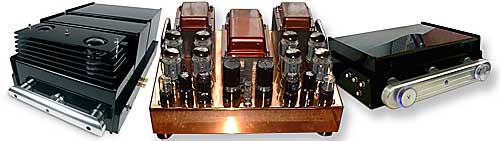
Three models are available, from the modest but very capable 15-watt stereo, to the stunning 60-watt monoblocs.
Retail Prices
• 15 watt stereo – Price on application.
• 30 watt mono-block – Price on application.
• 60 watt mono-block – Price on application.